Wall-mounted or portable dilution systems, and ready-to-use products: how to make the right choice?
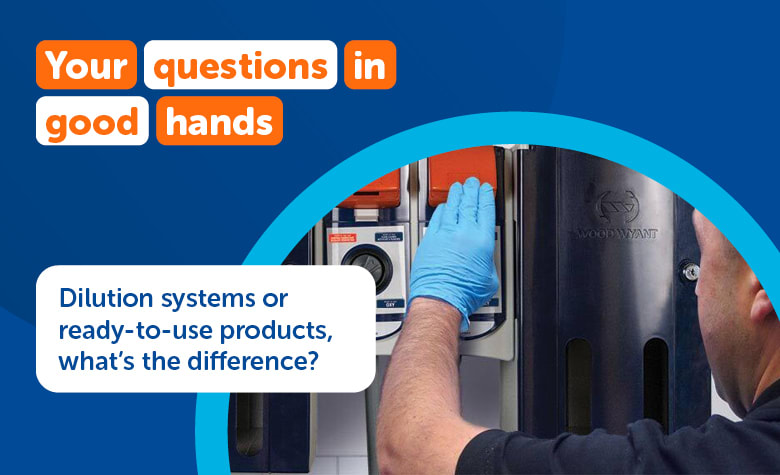
In institutional environments, every detail is important to ensure cleaning and sanitation operations that are efficient, safe, and consistent.
However, when it comes to product dilution, several questions tend to come up.
- Is it better to choose ready-to-use products or dilution systems?
- What are the real impacts on operations?
- How to make the right choice for your specific needs?
To shed a light on the subject, we spoke with Alexandre Bélanger, a Sani Marc technician who works daily in the field with institutional clients.
When is it better to use a dilution system with concentrated products instead of ready-to-use (RTU) products?
RTU products are still a relevant choice in some situations, particularly in less structured environments, for occasional use, or when usage volumes are low. Their main advantage lies in their simplicity of use, since they require no installation or dosing management.
However, when cleaning and sanitation operations become more structured or volumes increase, dilution systems with concentrated products provide clear advantages. They deliver accurate, consistent dosing, optimize cost efficiency, and standardize practices across teams. They also reduce direct handling of products, improving operational control.
Portable dilution systems provide an attractive compromise between the two approaches. They combine the simplicity of RTU products with more precise dosing control, while offering greater operational flexibility.
In what type of environments are dilution systems most commonly found?
Dilution systems are mainly used in high-traffic environments with demanding standards, such as hospitals, long-term care facilities (CHSLD), youth centers, schools, and retirement homes.
There are currently two main categories of systems on the market:
- Wall-mounted dilution systems: fixed to the wall and connected to water.
- Portable dilution systems: pre-set containers with an integrated dosing mechanism.
Each approach comes with key differences:
- Cost-efficiency: both solutions use concentrated products. Wall-mounted systems typically offer better dosing control, helping reduce cost-in-use.
- Simplicity: portable systems are easier to implement and require no installation.
- Flexibility: both systems can be used side by side within the same facility, depending on needs and consumption volumes.
As mentioned by Alexandre Bélanger, combining both approaches is common practice. Wall-mounted systems can be used for high-frequency applications, while portable systems can be used for specific areas or occasional use.
Why does dilution matter so much?
Product dilution plays a critical role and directly affects:
- Cleaning efficiency
- User safety
- Operational costs
Improper dilution can result in:
Overdosing, leading to product waste, surface damage, and potential toxicity risks.
Underdosing, reducing effectiveness.
Inconsistent results from one user to another.
In practice, these variations are common when dilution is done manually or in a non-standardized way.
What is the main difference between RTU products and dilution systems?
RTU products are easy to use and do not require any dilution.
On the other hand, dilution systems ensure the correct concentration is automatically achieved from a concentrated product.
The main difference, however, lies in operational control and cost management.
Dilution systems provide:
- Accurate, consistent dosing
- Reduced waste
- Improved cost predictability
They are part of a broader strategy to optimize operations, particularly in structured environments.
What are the concrete benefits of a dilution system?
On the ground, several benefits are quickly observed after implementation:
1. More consistent results
Automated dosing eliminates differences between users and work shifts.
2. Ease of use
The systems are intuitive and clearly identified, making them easier to adopt.
3. Cost savings
Using concentrated products reduces waste over the medium and long term.
4. Better organization
Fewer products to store, reduced clutter, and simplified management.
Does a dilution system actually improve safety?
Yes, and it is one of its main advantages.
Wall-mounted dilution systems help:
- Restrict access to concentrated products, improving safety.
- Integrate lockable cabinets to prevent product theft.
- Minimize the risk of improper use.
Portable dilution systems also enhance safety, since the concentrated product remains in a sealed container, significantly minimizing handling and direct exposure.
As noted by Alexandre Bélanger, in environments such as youth centers or healthcare facilities, this level of safety is essential, particularly to prevent unauthorized access to products.
Are dilution systems difficult to use?
Despite what some may think, these systems are generally:
- Easy to understand
- Clearly identified
- Quick to use
However, some more complex systems, such as those connected directly to water and requiring manual adjustments, may raise concerns among users.
This is why ease of use and clarity are key to adoption.
What are the most common issues encountered in the field?
In the field, certain issues repeatedly occur, regardless of the system used.
1. Technical issues related to water
- Une pression d’eau inadéquate peut entraîner une dilution incorrecte.
- Une mauvaise installation peut compromettre la précision du dosage.
2. Safety and installation issues
- Risk of water leaks if systems are poorly maintained.
- Need for certified backflow prevention systems to prevent water system contamination.
Some issues are specific to wall-mounted systems:
- Wear of components (valves, hoses).
- Damage caused by handling or impacts.
- Maintenance required to prevent residue buildup.
Preventive maintenance of wall-mounted systems is recommended at least once a year, and more often depending on usage levels and operating conditions.
One issue specific to portable systems:
- The integrated dosing tip leads to more technical plastic waste.
Despite these issues, both systems remain reliable when correctly implemented and used.
How does the installation of a dilution system work?
Adoption is typically positive.
During installation:
- Systems are clearly labeled.
- Staff receive on-site training.
- Managers are involved.
The expert highlights the importance of training both managers and users to ensure optimal use from the start.
What advice can be given to a client who is unsure about the two options?
According to Alexandre Bélanger, the choice largely depends on the context.
However, three main factors should be considered:
- Required control level
- Safety requirements
- Usage volume
In high-use or high-risk environments, dilution systems are typically a better choice than RTU products.
Optimize your operations with Sani Marc
Choosing between RTU products and dilution systems is a strategic decision that directly affects your operations.
At Sani Marc, we help you assess your needs, optimize your practices, and implement solutions tailored to your reality.



Products and Solutions

Like what you’re reading?
Get practical, expert-driven advice—sent straight to your inbox